
I’ve been drawn to St. Francis de Sales for years now. Something about him—his gentleness, his wisdom, his practical spirituality—kept nudging me to learn more. A few years ago, I chose him as my Saint of the Year and asked him to pray with me and for me as I wrote my book On the Job with Jesus, scheduled to be published this fall.
Yes, choosing a saint is a Catholic tradition, but the study of temperaments goes back much further—long before Christianity, all the way to Hippocrates. Whenever I want to understand a person, a concept, or a framework more deeply, I research and I read. Over the years, I’ve read extensively about the temperaments from a Catholic perspective, especially because many of my clients seek coaching on leadership, management, and culture through a Christian lens. But temperaments are not just for Catholics; they’re part of the human story.
This time, instead of doing a simple Google search, I went to Magis AI. Artificial intelligence is still in its infancy, and yes, there’s plenty of controversy around using it professionally. I’ll admit—I use it often for editing and research. I’ve never been able to edit my own work objectively, and while AI sometimes shifts my voice (which I don’t love), I still find it incredibly useful.
I don’t like the idea that AI could replace jobs, but I also know it’s here to stay and will evolve. Studies show that more and more people are using AI in the workplace. Gallup reports that writing and editing top the list of professional uses. So, I’m not alone.
I’m writing about temperaments because awareness is foundational in my work as a coach, facilitator, trainer, and speaker. So many of the tools I use—strengths assessments, communication styles, saboteurs, leadership frameworks—are rooted in understanding ourselves. To grow, to achieve goals, to reach our greatest potential, we must know ourselves well. I meet my clients exactly where they are, in the present moment.
Where Temperaments Began
The earliest systematic study of human temperaments is attributed to Hippocrates (460–370 B.C.), who connected personality differences to the balance of four bodily fluids, or humors:
- blood
- phlegm
- yellow bile
- black bile
Later, Galen expanded this into the four classic temperaments:
- Sanguine — blood
- Phlegmatic — phlegm
- Choleric — yellow bile
- Melancholic — black bile
Hippocrates began the medical study of temperament; Galen organized it into the fourfold model that shaped Western thought for centuries.
This is very different from modern personality systems like Myers-Briggs, which classify people based on preferences such as introversion/extroversion or thinking/feeling. The ancient temperaments are not scientific diagnoses—they’re broad patterns of emotional energy, motivation, and behavior.
Magis AI summarized it well:
The ancient theory is historically important, but its explanation in terms of bodily humors is not accepted by modern medicine. Its lasting value lies in recognizing that people exhibit relatively stable patterns of emotion, motivation, and behavior.
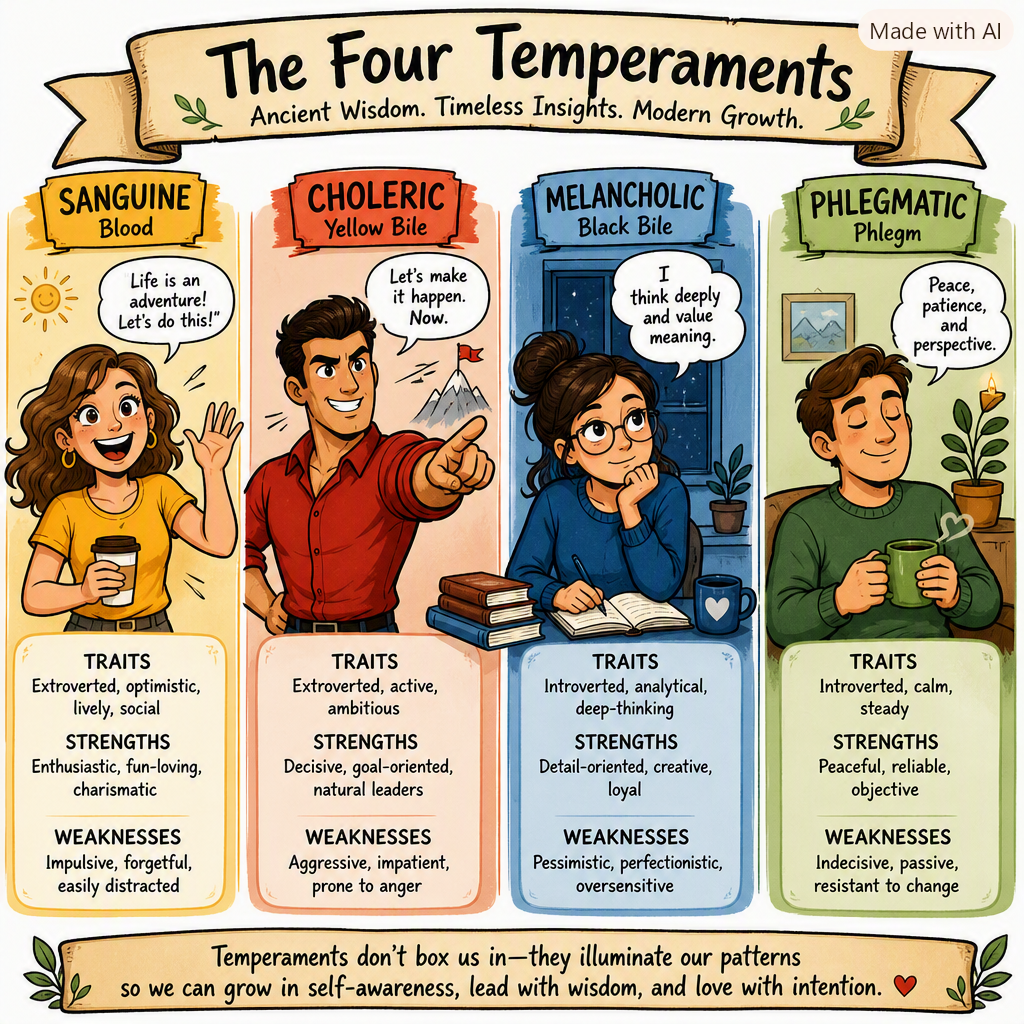
The Four Temperaments
Sanguine
Traits: Extroverted, optimistic, lively, social
Strengths: Enthusiastic, fun-loving, charismatic
Weaknesses: Impulsive, forgetful, easily distracted
Choleric
Traits: Extroverted, active, ambitious
Strengths: Decisive, goal-oriented, natural leaders
Weaknesses: Aggressive, impatient, prone to anger
Melancholic
Traits: Introverted, analytical, deep-thinking
Strengths: Detail-oriented, creative, loyal
Weaknesses: Pessimistic, perfectionistic, oversensitive
Phlegmatic
Traits: Introverted, calm, steady
Strengths: Peaceful, reliable, objective
Weaknesses: Indecisive, passive, resistant to change
While reading the book Piety an Personality: The Temperments of the Saints by Mary McGuire Berry, I laughed out loud when I read that St. Francis de Sales has the same temperaments I do, Melancholic and Choleric. I had an epiphany moments – I realized why I was so drawn to him.
Why Study Temperaments Today?
Whether you approach temperaments through faith, philosophy, or psychology, they offer a helpful lens for understanding human behavior. They’re not meant to label us or box us in. They’re meant to illuminate patterns—patterns that help us grow.
The more clearly you understand your temperament—your strengths, your weaknesses, your tendencies—the more effectively you can:
- communicate
- lead
- manage conflict
- build relationships
- pursue goals
- reach your potential
I’ve studied my own temperament, my husband’s, and my daughter’s. It’s helped me understand how we each respond to stress, how we make decisions, and how we show love. It’s helped me coach leaders, teams, and organizations with greater empathy and precision.
Self-awareness opens the door to transformation. Temperaments are simply one of the oldest keys we have in our toolboxes.
Vanessa Denha Garmo is the founder of Epiphany Communications: Coaching + Consulting. A Professional Certified Coach, trainer, facilitator, and consultant, she works with leaders and teams seeking growth in management, leadership development, communication strategy, and executive presence. Her work extends into culture-building, helping organizations strengthen credibility, connection, and the environments where people thrive.