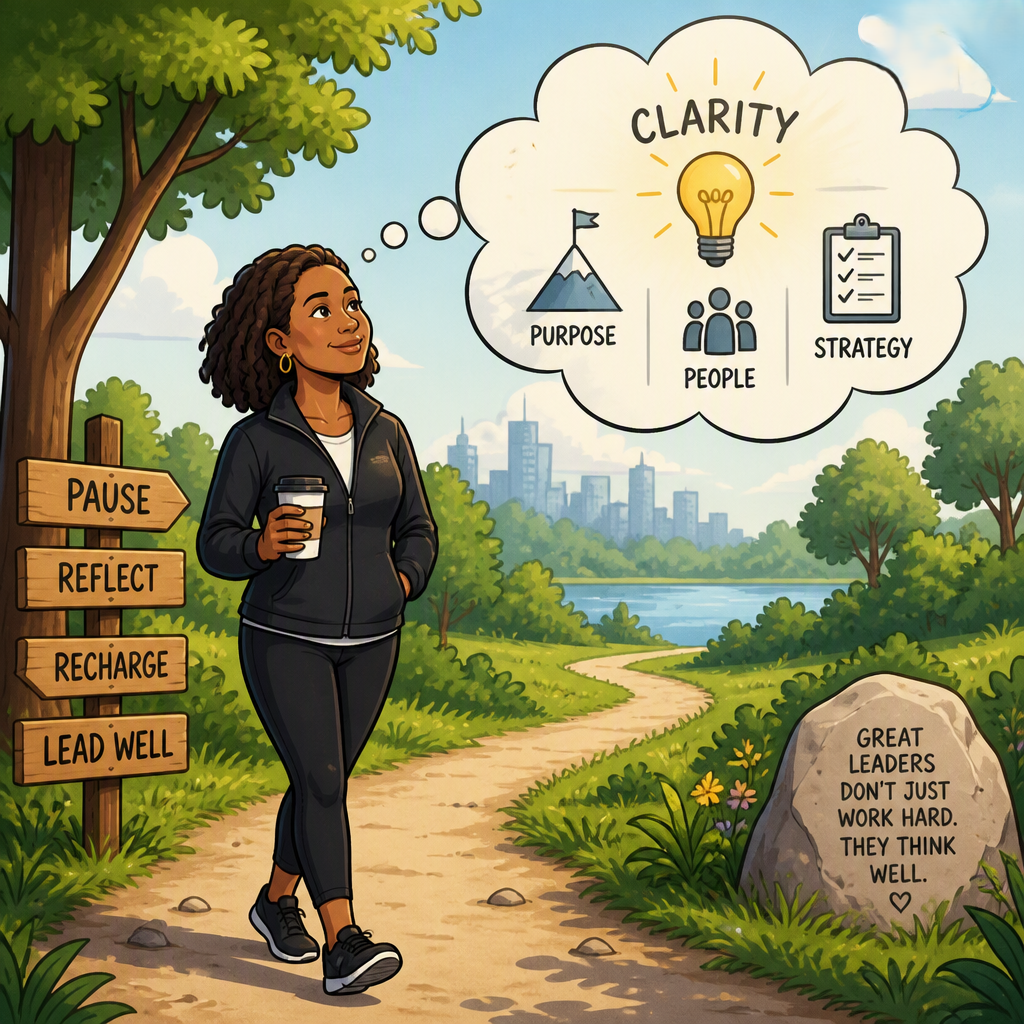

When the writer is staring at a blank page, the chemist can’t land the right formula, the coach can’t see the winning play, and the artist can’t find the David in the marble — what do you do?
You walk away. Literally, go for a stroll.
I’ve always noticed my best ideas show up when I’m not trying to have them—often on vacation, on a plane headed somewhere new, or during a long road trip. Those epiphany moments tend to arrive when I’m walking without headphones, not listening to a podcast, not filling the silence. The light bulb goes on in the quiet. Many people say that’s when we hear God’s voice most clearly.
Neuroscience backs this up. Inc. Magazine recently highlighted research showing that we’re often at our most creative when we’re not trying to be creative at all — when we’re doing nothing.
Researchers at Washington University in St. Louis used PET scans to see which parts of the brain activate during different activities. To establish a baseline, they asked participants to lie still and “do nothing.” Surprisingly, that resting state produced more mental energy across multiple brain regions than when participants were given tasks.
Later, neuroscientist Nancy Andreasen focused her work on these resting-state moments — what she called “free-floating periods of thought.” No tasks. No inputs, as highlighted in the Inc. article. No intentional creativity. Just mental stillness. In The Creating Brain, she writes that the brain is far from silent during rest; instead, it’s actively connecting thoughts and experiences. She named this process REST: random episodic silent thinking. During REST, the brain uses its most complex, integrative systems to link information in new ways.
Reading that article instantly reminded me of an old Big Bang Theory episode. The Einstein Approximation follows Sheldon as he becomes consumed by a physics problem — why electrons behave as if they have no mass when moving through graphene. He tries everything: equations for days, food models, marbles everywhere, even hiding in a mall ball pit. The harder he pushes, the further the answer drifts.
Eventually, exhausted, he remembers Einstein’s approach: stop forcing the solution. Do something simple. Sheldon takes a menial job at the Cheesecake Factory to “free his mind.” And it works. In the middle of serving tables, he drops a stack of plates — and in that moment of not trying, the insight finally clicks. He’d been looking at electron movement all wrong. Stepping away is what allowed him to see clearly.
That’s why ideas often show up while you’re walking, showering, doing dishes, or driving. When your mind isn’t locked onto a single task, it starts making connections on its own. It wanders. It remembers. It imagines. It tests possibilities and tosses them aside. It synthesizes. It plays.
As Andreasen writes, “When the brain/mind thinks in a free and unencumbered fashion, it uses its most human and complex parts.”
In simple terms: creativity needs breathing room. If you want fresh ideas, stop muscling your way toward them. Step back. Do something mindless. Let your brain idle. That’s often where the breakthrough lives.
Sometimes the most productive thing we can do is pause — to step away from the noise, the pressure, even the creative effort itself — and let clarity rise on its own.
Vanessa Denha Garmo, PCC, MA, is the founder of Epiphany Communications, where she facilitates and offers training in management, leadership, and effective communications. She is a leadership development coach and communications consultant. She is the host of the radio program Epiphany and is the author of the book Conversations That Create the Culture.