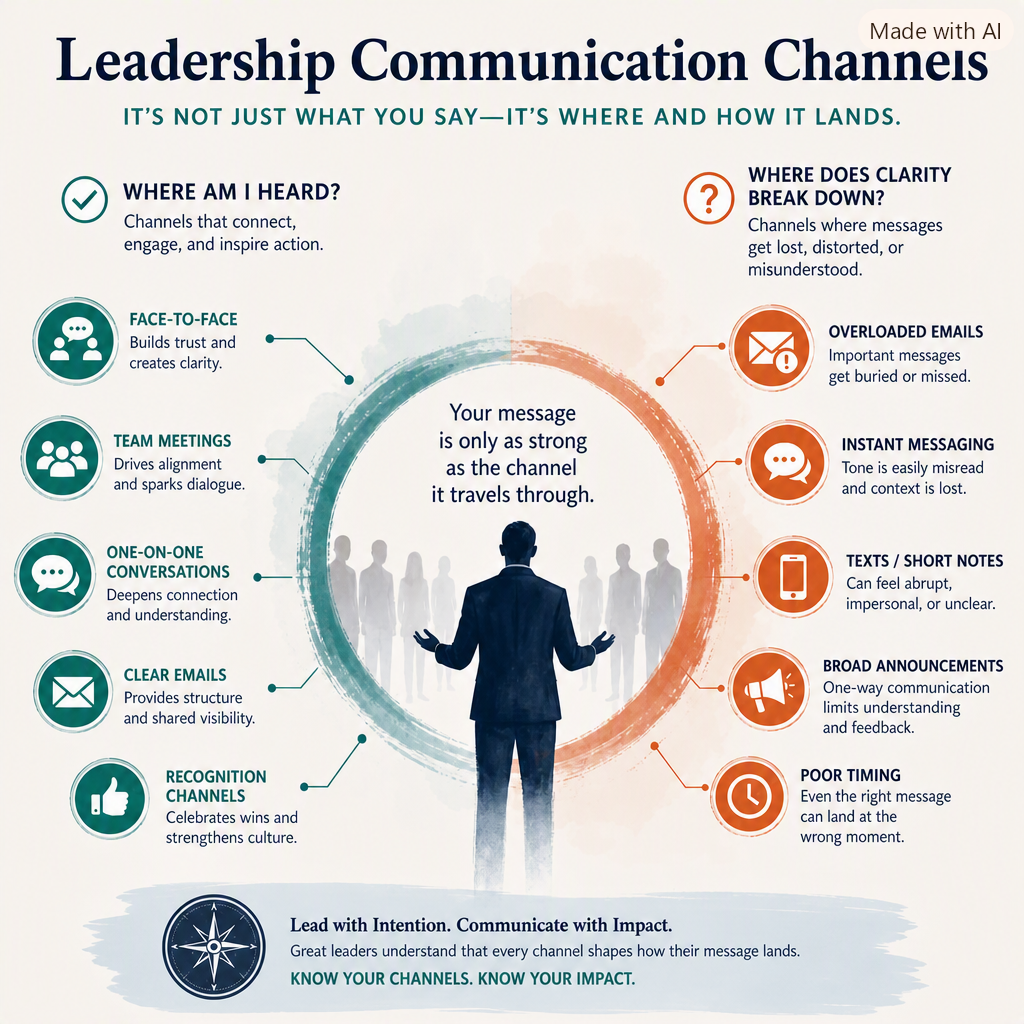

A Leadership Reflection on Communication Channels
One of the biggest blind spots leaders face isn’t what they communicate—it’s how their communication is received. In every organization, messages travel through multiple channels: email, meetings, texts, chats, hallway conversations, and now digital platforms that never existed a decade ago. But not every channel delivers clarity. Not every channel builds trust. And not every channel lands the way you intend.
Strong leaders don’t just send messages—they study how those messages travel.
Below are two simple reflection exercises that help leaders understand where communication is working, where it’s breaking down, and how to adjust with intention.
1. Where Am I Heard?
Every leader has channels where their voice carries weight—where people respond, engage, and take action. These are the spaces where communication feels natural, aligned, and effective.
Consider:
- Which channels consistently yield engagement or feedback?
- Where do my words spark action, not confusion?
Reflection Prompt: Think of a moment when your message deeply resonated with a team or individual. What made that communication meaningful? What channel did you use?
Often, the “win” wasn’t just the message—it was the medium. Maybe it was a face‑to‑face conversation that built trust. Maybe it was a voice memo that conveyed tone better than text. Maybe it was a team meeting where people could ask questions in real time. Identifying these strong channels helps leaders communicate with greater intentionality.
2. Where Does Clarity Break Down?
Every leader also has channels where communication gets muddy. Messages are misinterpreted. Tone gets lost. People walk away unsure of what’s expected.
Consider:
- Which modes of communication feel inconsistent or misaligned with intent?
- Are there gaps between what I mean and what others receive?
Reflection Prompt: Reflect on a time when a message didn’t land well. Was it the platform, the tone, the timing—or something deeper?
Sometimes the issue isn’t the message—it’s the channel. A complex directive sent through email can create anxiety. A corrective note sent through text can feel abrupt. A rushed announcement in a meeting can leave people confused. Understanding where clarity breaks down helps leaders recalibrate before miscommunication becomes culture.
Why This Matters
Communication channels shape culture. They influence trust, engagement, and how safe people feel speaking up. When leaders understand where they are heard—and where they are misunderstood—they can communicate with purpose instead of assumption.
Great leadership isn’t just about sending messages. It’s about ensuring those messages land with clarity, consistency, and care.
If you want, I can expand this into a longer blog, turn it into a workshop activity, or adapt it for your Conversations That Create the Culture book.